Psyche
Mission profile
- NASA / ASU
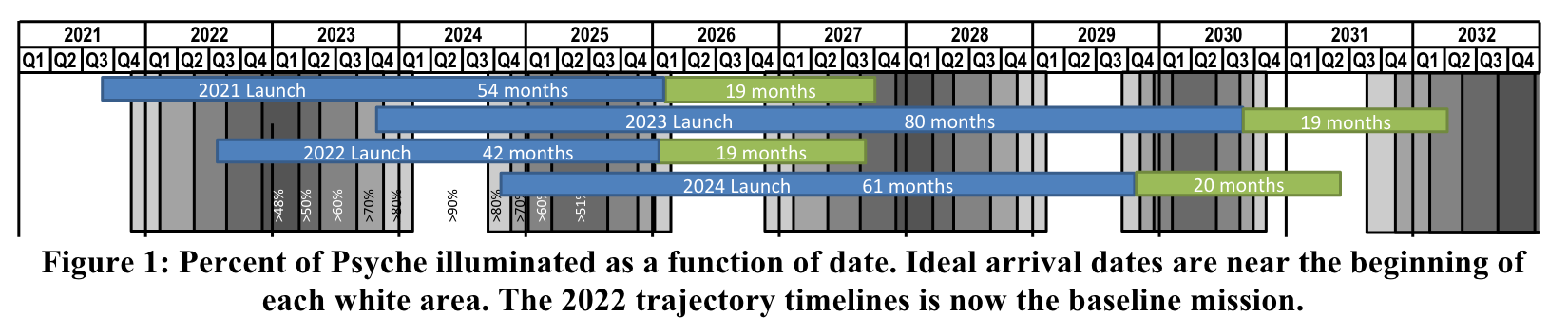
- Launch: 12 Oct 2023 14:16 UT
- Launch period open through Oct 25
- Initial checkout lasts 100 days
- First light for camera about 6 weeks after launch;
raw images will be posted online
- Mars flyby ~3000-4400km May 2026; thrusters not used except for trim from -60 to +2 days around flyby
- Psyche approach begins May 2029, about 100 days before orbit. Psyche ~ a few pixels
- Arrival at 16 Psyche: late July 2029. Asteroid ~500 pixels
- Further details on orbit operations from page 25 of press kit
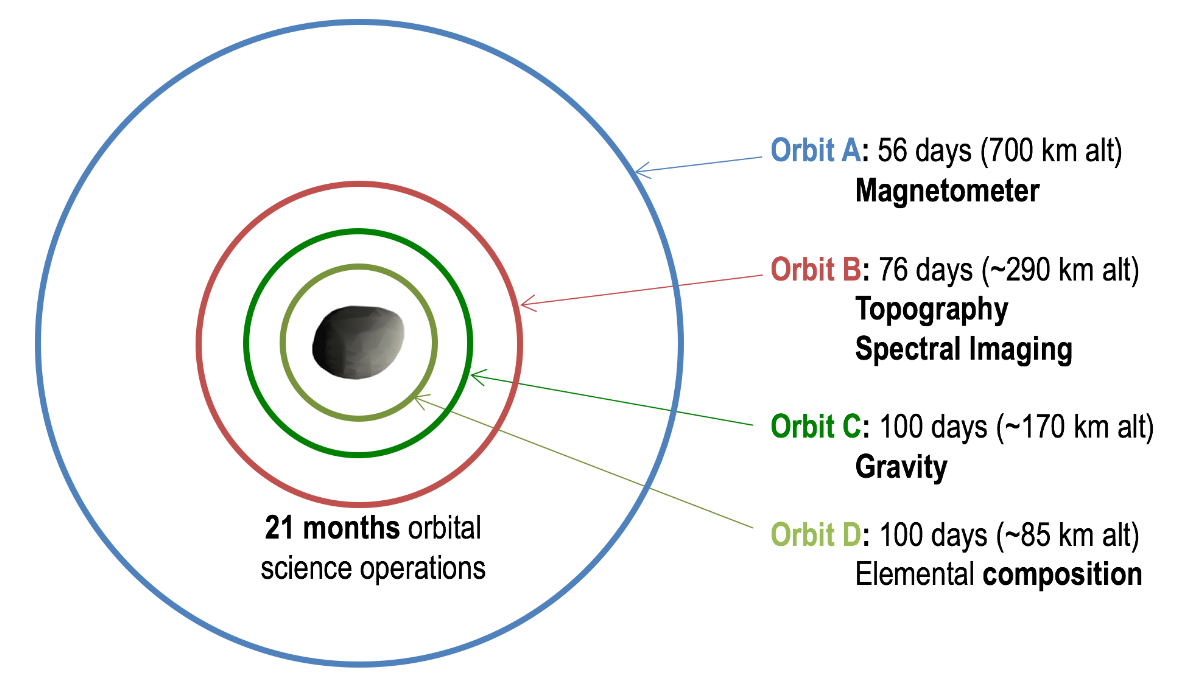
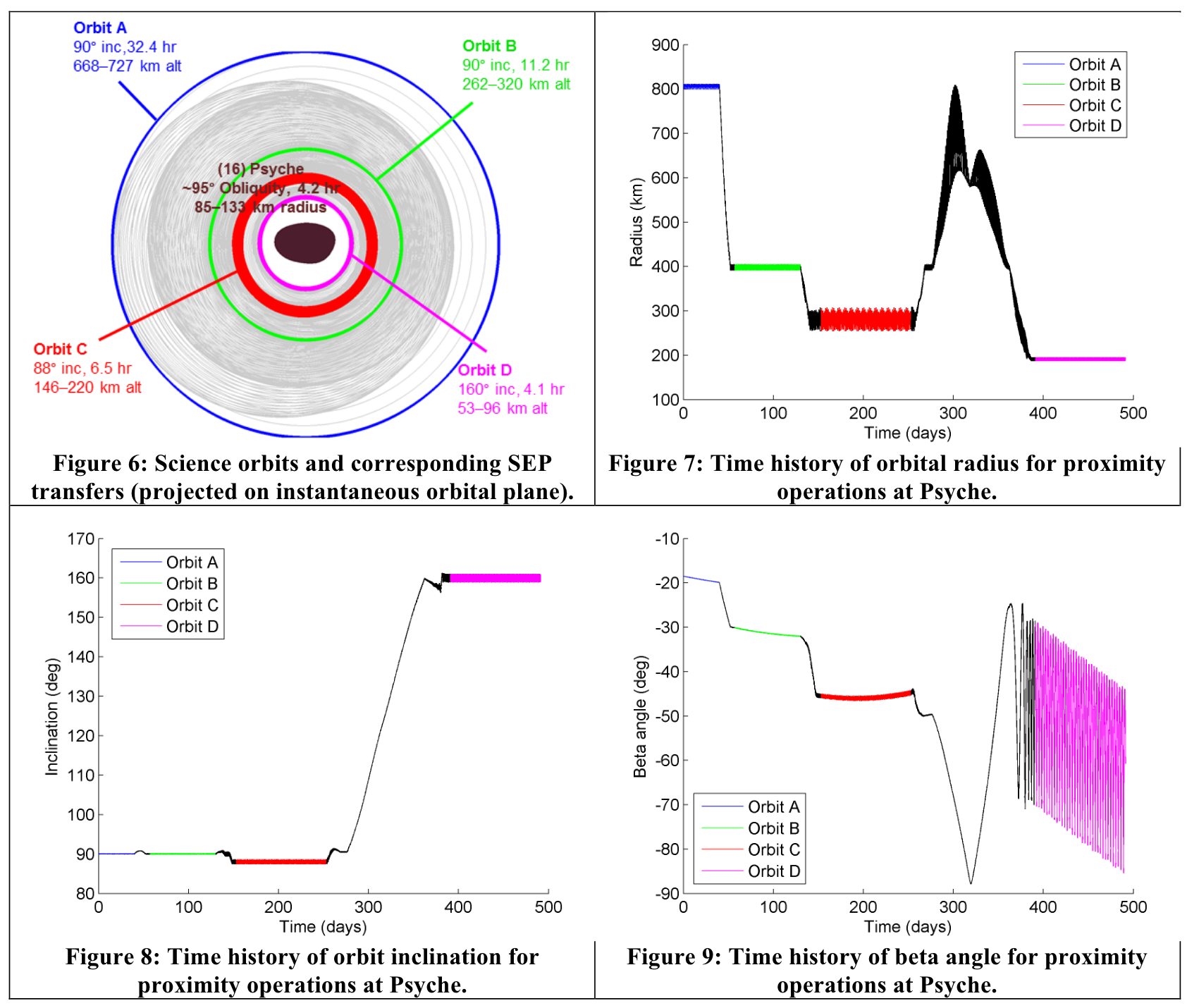
- Prime science mission to last 26 months, until Nov 2031
Upcoming events
- 10 Oct 0900PT/1600UT: NASA TV: Psyche mission and science briefing
- 11 Oct 0800PT/1500UT: (NASA TV: OSIRIS-REx asteroid sample reveal)
- 11 Oct 1000PT/1700UT: NASA TV: Psyche prelaunch briefing
- 12 Oct 0615PT/1315UT: Uncommented feed begins on NASA Media channel
- 12 Oct 0630PT/1330UT: Commented launch coverage begins on NASA TV
- 12 Oct 0716PT/1416UT: Launch
- About 4 minutes after launch, MECO, core sep, SES-1 (second engine start), fairing jettison
- SECO-1 at 8:24 minutes after launch
- Coast about 45 minutes
- About 55 minutes after launch, SES2, burn 2+ minutes, SECO2
- Psyche deployment an hour after launch
- Possible earliest contact with spacecraft 5 minutes after deployment
- Solar array deploy begins about 6 minutes after separation, one at a time
- Solar array deploy takes about 21 minutes, then orients to Sun, then goes into safe mode
Resources
Science
Science team & instruments
- PI: Lindy Elkins-Tanton, ASU
- DPI: Ben Weiss, MIT
- Program Scientist: Sarah Noble, NASA
- Project Scientist: Carol Polanskey, JPL
- Gamma-ray and neutron spectrometer (GRNS): heritage MESSENGER & Lunar Prospector, lead David Lawrence, JHUAPL
- Multispectal imager: heritage Curiosity Mastcam, lead Jim Bell, ASU
- Magnetometer: heritage MMS and InSight, lead Ben Weiss, MIT
- Gravity science: lead Maria Zuber, MIT
- Full team listed here
Science goals
- Understand iron cores, a previously unexplored building block of planet formation.
- Look inside terrestrial planets, including Earth, by directly examining the interior of a differentiated (layered) body, which otherwise could not be seen.
- Explore a new type of world – one made not of rock and ice, but significant amounts of metal.
Science objectives
- Determine whether the asteroid Psyche is a planetary core or if it is unmelted material.
- Determine the relative ages of regions of Psyche’s surface.
- Determine whether small metal bodies incorporate the same light chemical elements (including sulfur, potassium, and silicon) that are expected to be present in Earth’s high-pressure core.
- Determine whether Psyche was formed under conditions more oxidizing or more reducing than Earth’s core. In Psyche’s case, these terms refer to whether there is a lot of oxygen present in the asteroid’s metal compounds (oxidized) or little to no oxygen (reduced). Answering this question will help to determine the conditions of the environment in which Psyche formed.
- Characterize Psyche’s topography.
Engineering & physical facts
- PM: Henry Stone; DPM: Robert Mase, JPL
- Project System Engineer: David Oh; DPSE: Jennifer Maxwell, JPL
- Flight System Manager: Mark Brown; DFSM: Neil Dahya, JPL
- Missuion Operations Manager: Tim Weise, JPL
- Full team listed here
- Chassis: 2.9 x 2.2 x 2.4 meters, plus 2m boom for science instruments
- Span: 24.76 x 7.34 meters
- Each solar array: 11.3 x 7.34 meters
- HGA: 2m diameter
- Solar arrays generate 21 kw near Earth, 2.3 kw at Psyche
- Spacecraft can tolerate eclipses as long as 65 minutes (Oh et al. 2017)
Asteroid 16 Psyche
- Diameters: 290 x 245 x 170 km, effective diameter 226 +/- 5 km (E-T et al 2020)
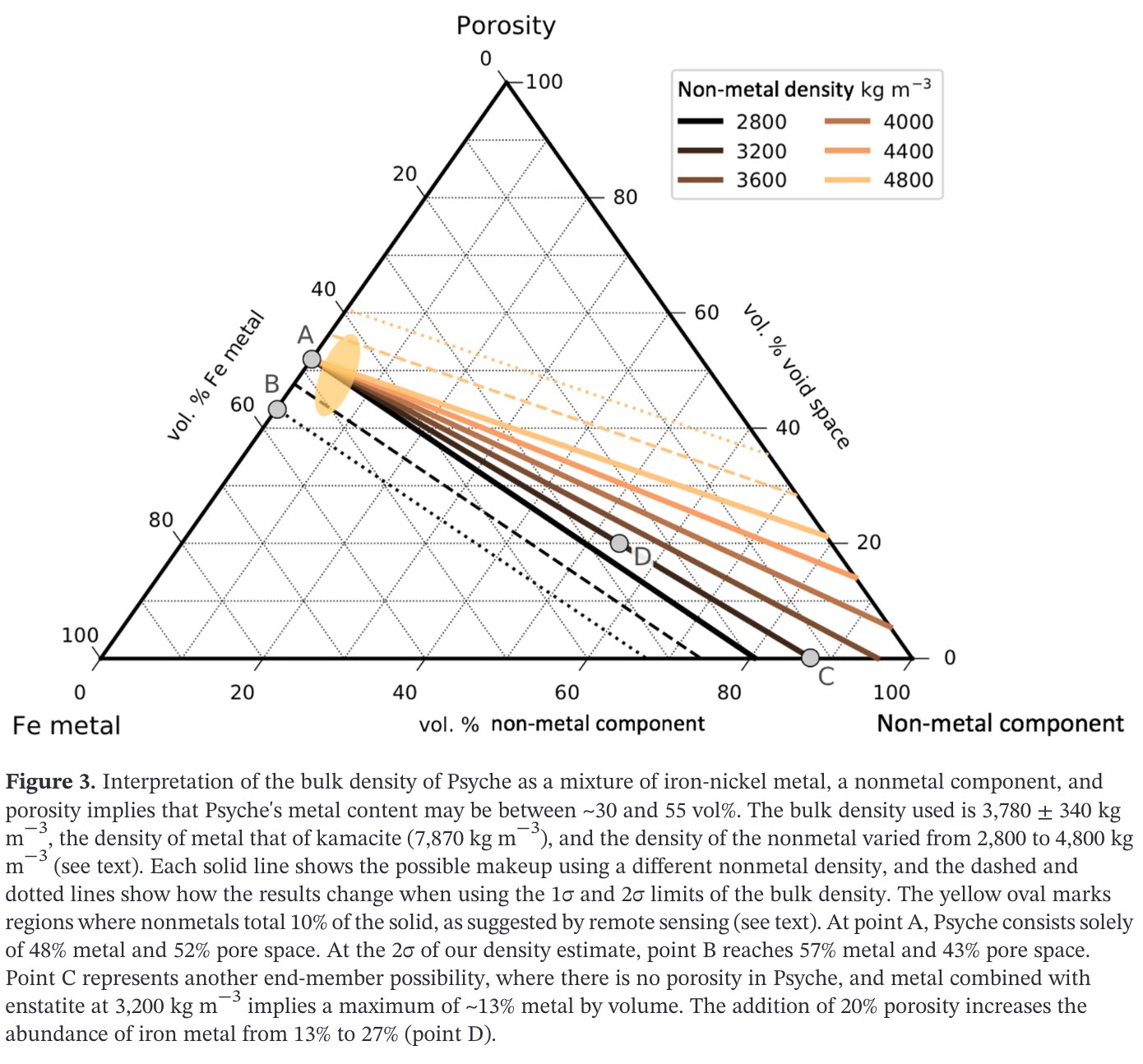
- Density estimates range from 2500 to 7600 kg/m3; preferred value 3780 +/- 340, or between the density of Vesta and the density of pure troilite plus 20% porosity; most likely composition considered to be 30-60% metal by volume (E-T et al 2020)
Images
Mission/spacecraft
16 Psyche
References
Spacecraft/mission design
- Elkins‐Tanton, L. T., E. Asphaug, J. F. Bell, H. Bercovici, B. Bills, R. Binzel, W. F. Bottke, et al. “Observations, Meteorites, and Models: A Preflight Assessment of the Composition and Formation of (16) Psyche.” Journal of Geophysical Research: Planets 125, no. 3 (March 2020). https://doi.org/10.1029/2019JE006296. Goes through measurememnts of size and mass of 16 Psyche, explores possibilities of composition and formation scenarios.
- Oh, David Y, Steve Collins, Dan Goebel, Bill Hart, Gregory Lantoine, Steve Snyder, Greg Whiffen, et al. “Development of the Psyche Mission for NASA’s Discovery Program.” In The International Electric Propulsion Conference, 19. Georgia Institute of Technology, Atlanta, GA, 2017. Includes information on choices of trajectories to Psyche and trade-offs in science orbits; avionics; solar-electric propulsion system.
- Polanskey, Carol A., Linda Elkins-Tanton, Ralf Jaumann, David J. Lawrence, Danielle M. Marsh, Robert R. Moore, Ryan S. Park, et al. “Psyche Science Operations Concept: Maximize Reuse to Minimize Risk.” In 2018 SpaceOps Conference. Marseille, France: American Institute of Aeronautics and Astronautics, 2018. https://doi.org/10.2514/6.2018-2703. Explains in detail how each science orbit will work, with lessons learned from the Dawn mission.